
Radford Deed Records and Transfer Papers
A recorded Radford deed is a public instrument. It documents a conveyance or another stated interest in land. The Circuit Court Clerk indexes more than deeds. Deeds of trust, releases, plats, judgments, financing statements, wills, and fiduciary records all appear in the same body of records. Several of these entries can touch one parcel while serving different roles. A deed records a transfer. A deed of trust or a lien reflects an obligation or claim. Each must be checked on its own terms.
The Clerk's local pages do not publish the full live SRA document-type menu. The categories documented by the Clerk and its access notes stand in for it. One caution applies. No single instrument in the index proves ownership by itself. Radford's chain of title begins with the recorded deed. Its named parties, legal description, PIN, and instrument reference anchor the record.
| Deed Type | What It Does | Common Use |
|---|---|---|
| Recorded conveyance deed | Names the parties, land description, and stated transfer | Trace a change in ownership |
| Executor or administrator deed | Records a transfer made through estate authority | Follow a death-related conveyance |
| Deed of trust | Records a land-secured financing interest | Check an encumbrance and its later release |
| Release or satisfaction | Records discharge of a listed obligation | Confirm a later filing against the parcel |
| Recorded plat reference | Connects a lot description to a filed drawing | Read a subdivision lot with the deed |
Radford land records often split a transfer and its encumbrances across separate instruments. A deed reference alone does not show that a loan, judgment, or other claim was ever released. When the parcel question turns on it, follow the later release or satisfaction through the index.
Radford Index Years Differ from Image Years
The Clerk's coverage note gives two different dates. Scanned land-index material reaches back to January 1918. Online deed indexing begins in April 2000. Images are incomplete before May 30, 1999. Those dates describe separate services. An older name or instrument reference may be visible in the index even when its image cannot be opened remotely. The 1918 date marks the scanned range rather than the start of Radford land ownership.
Other record groups have their own start dates. Financing statements begin in June 2000, general miscellaneous records in September 1998, judgments in April 2000. Marriages and wills or fiduciary records begin in 2000. A missing result can reflect a record-group or image boundary instead of an absent filing. Ask the Clerk which book, index, or microfilm run covers the date you need.
The Radford Clerk's coverage page separates the land index years from the image years.
The Virginia SRA/COVERS entry screen is the remote starting point for land-record index research.
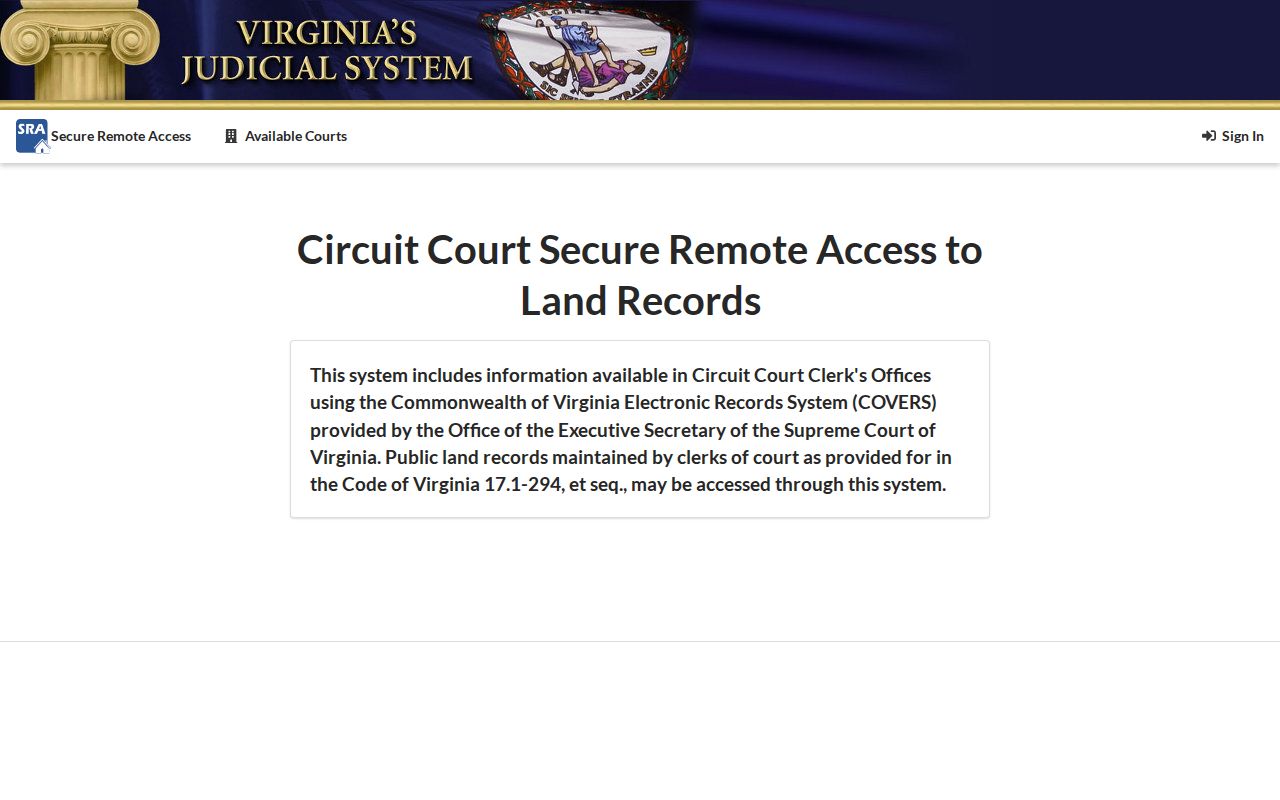
The portal leads to the index, while Radford's local subscription rules govern deed-image access.
Radford Grantor and Grantee Steps
The grantor is the party conveying an interest. The grantee is the party receiving it. Radford SRA is the official route into the Clerk's land index. The live search form is not text-rendered. Exact button labels and dropdown options cannot be listed here. Use party names, record group, date, and instrument reference as clues. Apply them where the portal offers them. Confirm any result against the document image or the counter record.
Start with the newest deed matching the parcel, not the first same-name hit. Read the grantee, prior grantor, PIN, legal description, and recording reference. Search the prior grantor as an earlier grantee to step back through the chain. Keep deeds of trust, releases, and judgments as separate entries. The chain can branch through an estate, trust, or joint ownership. Check any name sequence against the land description itself.
| Party name | Grantor or grantee named in the recorded instrument |
|---|---|
| Record group | Land, judgments, financing, miscellaneous, wills, or fiduciaries |
| Date clue | Use a known transfer or recording period to narrow candidates |
| Instrument reference | Compare the card's ID or deed reference with the Clerk result |
- Grantor
- The party identified as conveying an interest in the instrument.
- Grantee
- The recipient named in the recorded transfer.
- Chain of title
- The ordered set of recorded conveyances affecting a parcel.
- Book/page and instrument ID
- Different reference formats that lead to a filed document; use the value printed in the source record.
Radford Recording Rules Tie a Deed to Its Parcel
Radford recording instructions ask a deed affecting local real estate to state the city's jurisdiction. The deed must also give the tax-map number and account or PIN. Grantor and grantee names, grantee address, consideration, legal description, and the applicable value or exemption information complete the list. Execution and notarization are required too. That is why a parcel identifier matters. The full legal text matters as well. An old street name may no longer locate the property.
The recording page also covers cover sheets and plat specifications. A plat must be original and unreduced. It can be no larger than 18 by 24 inches. It also needs a preparer's stamp and signature and readable lettering. A reduced exhibit must point back to the oversized plat's prior recording reference. For a subdivision lot, compare the deed's lot and subdivision wording against that filed drawing.
The Radford land-record instructions list the local recording requirements.
The recording page displays the PIN rules. It also shows the plat rules that connect an instrument to a lot.
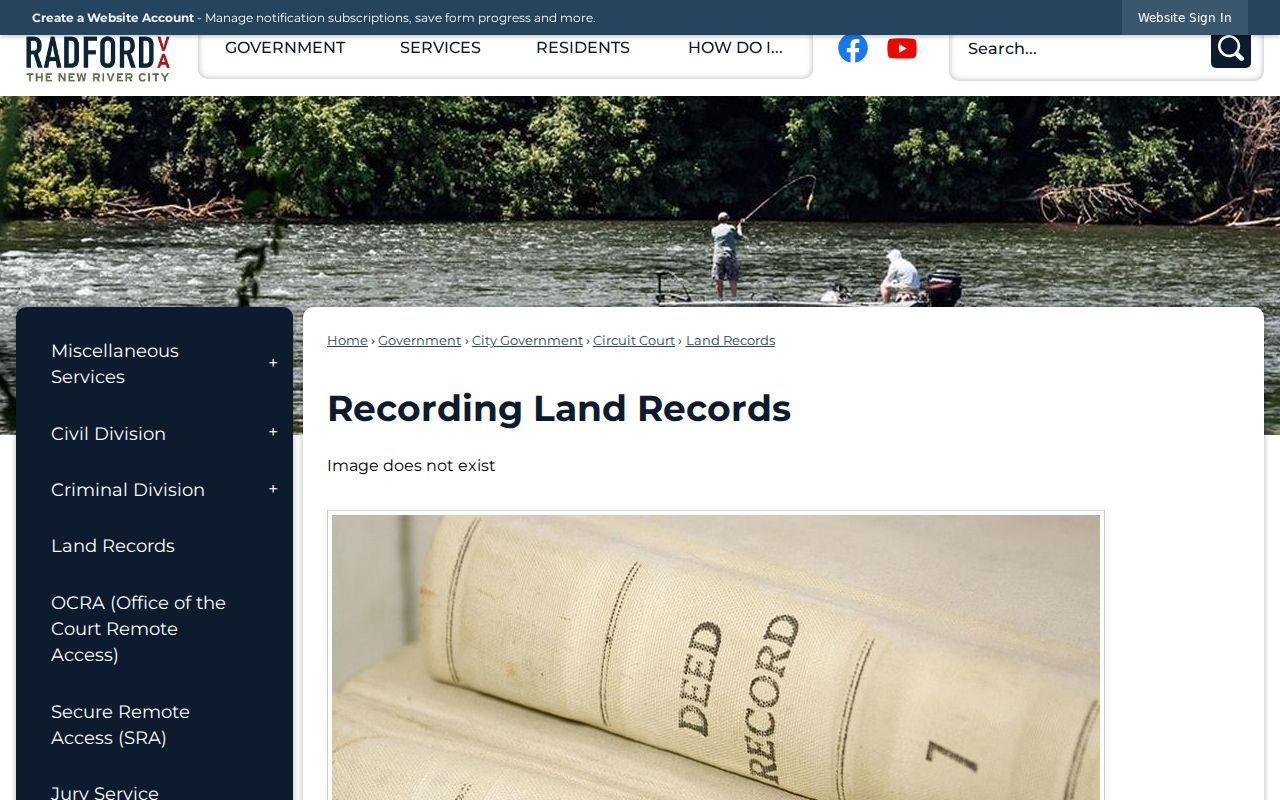
For title work, rely on the recorded legal description and the actual plat, not a parcel-card summary alone.
Older Radford Deed Books Need a Clerk Route
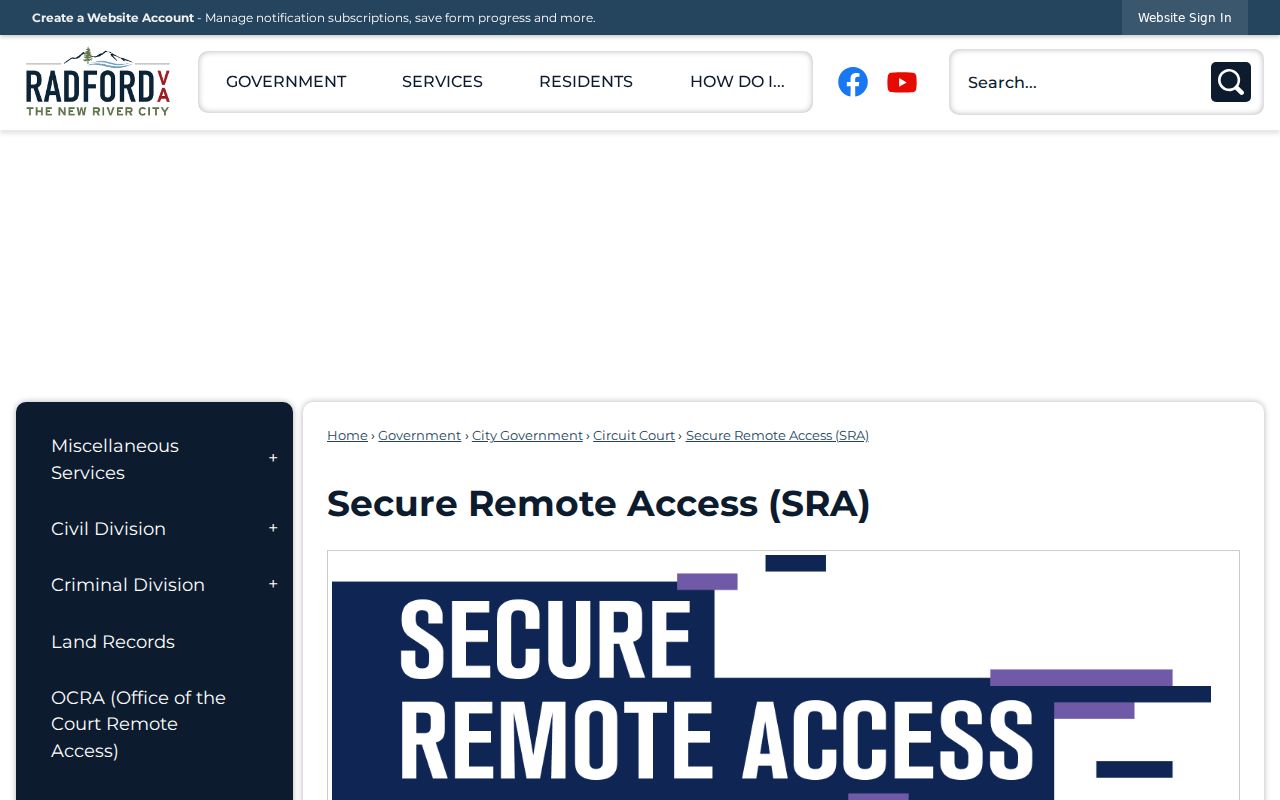
Radford's online index is one of two ways in. The other runs through the Circuit Court Clerk's counter. There, deed records can be reviewed in person. Call ahead before trusting an older image or book reference. Staff can tell you whether the volume you need sits on a shelf. It may instead be on microfilm. Remote image access works through Secure Remote Access, or SRA. The local SRA instructions supply the application. Applications go by mail to 619 Second Street, Attn. SRA. Individual plans run $50 monthly or $300 yearly. Business terms list $300 per year for the first user. Each added user costs $275.
The counter has its own rules. The office posts no schedule of copy charges, so ask the price before ordering pages. The statewide system may offer free index-only access. Images still require local authorization. Hours run 8:30 a.m. to 4:30 p.m. on weekdays, and recording stops at 4:15 p.m. Pre-index material may live in deed books, plat books, wills, fiduciary books, or microfilm. Ask which record group and date range staff can pull before you travel. The local SRA page also explains why an index hit may not include an image.
A missing online document is not a dead end. The Clerk can point the search toward the right counter volume or copy request, and staff handle older deed records every day.
Walk the Radford Grantor-Grantee Chain
The grantor-grantee index anchors every Radford deed search. Start with the most recent deed tied to the PIN or legal description. Then search the grantor and grantee names printed on that instrument. That pair becomes your next query. Walking backward this way suits house history and transaction review, but every result must describe the same tract before it counts as one chain.
Keep a timeline as you go. Record the recording date, parties, document type, PIN or legal text, and the book/page or instrument reference for each hit. The assessor card offers a current clue. The Circuit Court Clerk holds the filed deed itself. A recent deed may not yet appear in the annual land book, so the recorded instrument can be the newer source.
- Locate the newest deed for the PIN or legal description and record its date and reference.
- Read the grantee and grantor exactly as printed, including an estate or entity name.
- Search the prior grantor as an earlier grantee and compare the legal description.
- Continue until the result leaves the online index, then ask the Clerk about older books or microfilm.
- Grantor
- The party identified as conveying the interest.
- Grantee
- The recipient named in the deed.
- Chain of title
- The sequence of recorded transfers affecting one parcel.
- Book/page vs. instrument ID
- Clerk references in different formats; preserve the exact value shown.
Request a Radford Deed Copy
The SRA index is only step one. The image comes through a Clerk-approved subscription. Apply by mail, use an authorized remote account, or visit the counter and ask about a copy. No counter-copy or certification fee is published. Confirm the amount and format before sending payment. A card charge at the office carries a listed $2 surcharge.
Give the office what it needs to find the record. Include the parties, an approximate recording date, the instrument or book reference, and the PIN or legal description. If the item predates the online image range, ask whether staff can pull a deed book, plat, or microfilm reel. Virginia's FOIA covers existing public records. Copy procedures for land records, though, are set by the Clerk's recording office.
Recorded, not guaranteed. An index entry shows a recorded filing, not a title opinion or proof that no other interest exists. Review the full chain and obtain qualified title advice before relying on ownership.
Radford Clerk Hours Shape the Recording Route
The Radford Circuit Court Clerk sits at 619 Second Street, Room 149, Radford, VA 24141. Weekday hours are 8:30 a.m. to 4:30 p.m. Instruments for recording are accepted only until 4:15 p.m. That cutoff matters when a closing, plat, or deed correction arrives in person. Confirm any special schedule before you travel. Holiday and court closures can shift the routine.
When a record will not open through Virginia Secure Remote Access, give the Clerk the parties' names, an approximate instrument date, a book or instrument reference if known, and the parcel identifier. Index coverage and image coverage differ. Older entries may need staff or counter access. No complete counter-copy fee schedule is posted, so ask the Clerk to quote the cost before ordering multiple pages or certified copies.
An address alone may not isolate the instrument. When that happens, add the PIN or legal description from the Radford parcel card. That detail separates a deed touching one lot from a similar name or a neighboring parcel.