
The Radford Current Owner Record Card
Radford's parcel card packs a lot into one view. The OWNER field sits beside location data, tax identifiers, and document references. An OWNER_ALT line carries alternate text for the owner. Separate OWNER_STREET fields carry the owner's mailing address, while PROPERTY_ADDRESS pinpoints the site itself. A card may also list the PIN, tax account, assessed values, and sale amount. Deed and plat references can appear, with a direct link to a PDF copy.
One caution applies. A current owner of record is not the same as an occupant. A public card never certifies title. A transfer may just have been recorded. Or the name may matter for a land transaction. In either case, go to the latest deed. The card works best when its identifiers carry into the Clerk's index.
| OWNER and OWNER_ALT | Public owner strings shown for the parcel |
|---|---|
| PIN and TAX_ACCOUNT | Map parcel and tax-roll keys |
| PROPERTY_ADDRESS | Site location, separate from mailing fields |
| OWNER_STREET fields | Owner correspondence address where populated |
| DEED_REF and INSTRUMENT_ID | References for a recorded filing |
| RECORDED and SALE_AMOUNT | Recorded and sale-related fields when populated |
OWNER is a tax-roll field, plain and simple. It is not a list of everyone living at the property. OWNER_STREET may point to an out-of-city owner, an estate, a trust, or a representative instead. Radford's sample record happens to show matching site and mailing addresses. Even so, the data model keeps those roles separate. Never infer where someone actually lives from the mailing line.
Radford OWNER Fields Show the Recorded Name
The current parcel service labels its dataset Real_Estate_2025. Its fields include OWNER, OWNER_ALT, PIN, ALT_PIN, TAX_ACCOUNT, DEED_REF, PLAT_REF, INSTRUMENT_ID, and RECORDED. The owner string might name a person, a company, or a trust. It might also name an estate or joint owners. Search the text exactly as it appears. Skip punctuation tricks and entity variants at first. A surname alone can drag up unrelated parcels.
Connected references let you verify what you find. Match the card's PIN and legal or subdivision fields to the deed. Do not trust a name string alone. When a parcel card links a PDF, save the account or PIN with the copy. A later deed search can then reuse the same identifier. The Radford parcel layer lists the owner and cross-reference fields. For hands-on lookups, the Real Estate App is the public search interface.
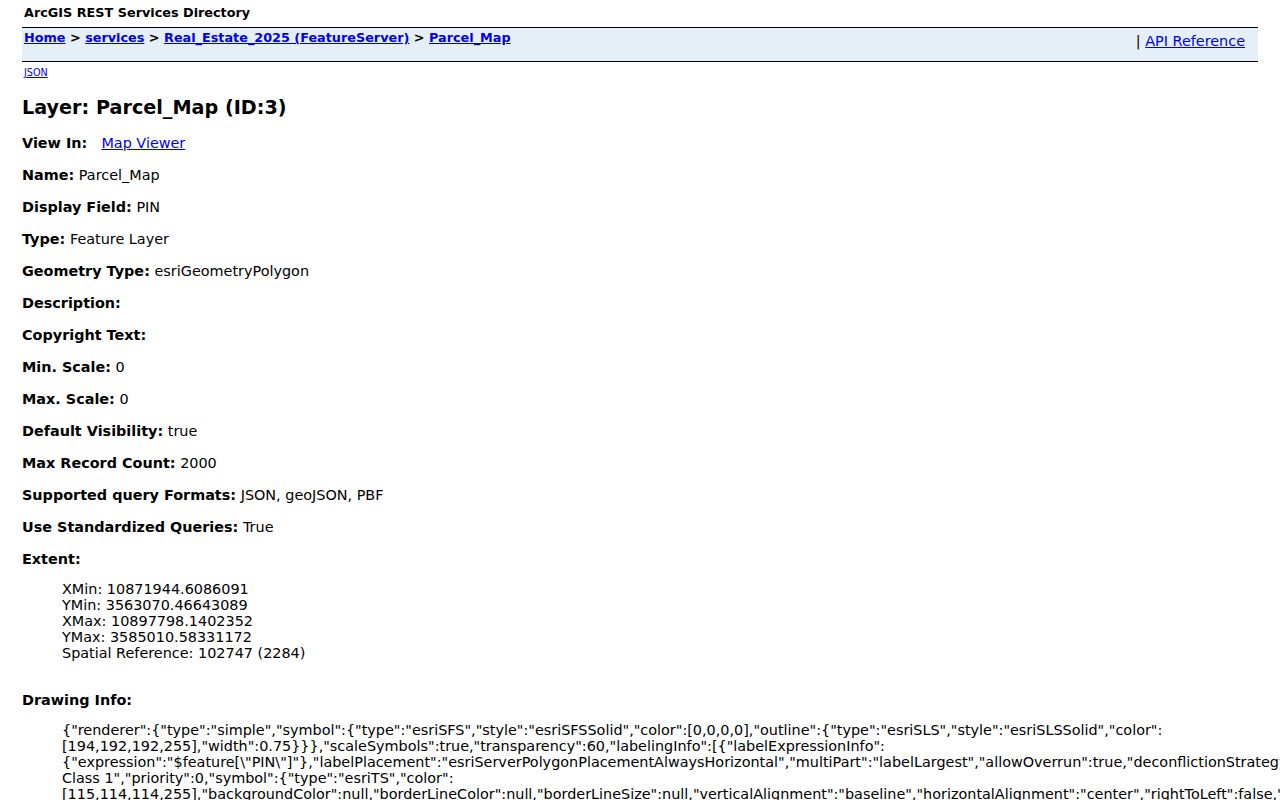
The schema shows the owner string sitting beside a parcel's separate legal and address references.
Radford Situs and Mailing Lines Differ
Radford records draw a firm line between site and mail. PROPERTY_ADDRESS marks where the mapped parcel lies. OWNER_STREET, OWNER_CITY, OWNER_STATE, OWNER_ZIP, and OWNER_ZIP_PLUS4 tell where correspondence goes. Both can point to the same place. They can also diverge entirely.
The gap matters after a sale. It also matters when a trust, company, estate, or out-of-city owner holds the parcel. Use the situs to place the parcel on the map. Then keep the mailing fields as part of the tax-card record. A mailing address never establishes occupancy or a current home address.
How Current Is the Radford Owner Field?
Radford sets January 1 as its annual assessment date. From there, the land book is updated using deeds, plats, and wills the Clerk records. The city publishes no average lag between a closing and a card update. A deed filed after January 1 can be the newer legal record. Meanwhile, the current tax-year card may still list the prior owner.
When the owner field and a recent sale disagree, compare the land-book year with the latest recording date. Ask the Commissioner which assessment entry is displayed. Ask the Clerk which deed was recorded most recently. This is a timing difference between two record systems. It is not one office certifying the other's result.
- Open the Radford parcel card and write down its owner string, PIN, tax account, and deed reference.
- Search the Circuit Court Clerk's index for the matching recorded deed and compare its legal description.
- Check the recording date against the assessment year shown by the Commissioner.
- For an entity owner, use Virginia SCC filings for entity context, not as a substitute for the deed.
- Owner of record
- The name carried in the parcel layer or assessment roll.
- Assessment roll
- The annual land book maintained by the Commissioner.
- Situs and mailing
- Site location and owner correspondence fields, stored separately.
- Recording lag
- The gap between a filed deed and a later land-book display; no average is published locally.
Confirm the Current Radford City Owner
Start with the card's parcel key and its latest deed reference. Search the matching SRA entry. Open the instrument if authorized. Compare the grantee, the PIN, and the legal description. A similar name without the same land description may belong to another property. The reference may predate the available image range. If so, ask the Clerk about counter access or the older book record.
Coverage has limits worth knowing. Radford's land index is scanned back to January 1918. Deed indexing begins in April 2000. Images run incomplete before May 30, 1999. Index coverage and image coverage are separate things. A current-owner review should stop at the newest confirmed transfer. Tracing every former owner belongs to the longer historical chain. The local SRA information explains coverage and subscription image access. For copies and record types, the Radford deed-record page has the details.
Radford Entities and Joint Owner Names
Radford's OWNER field is not always a single person. It may hold an LLC, a trust, an estate, a life tenant, or a joint-owner string. Copy the legal text as shown. Then compare it with the deed's grantee line before drawing any conclusion about ownership. When a company holds the land, the Virginia SCC search can confirm entity status, the registered agent, and filing context. It does not name the parcel owner. Only the deed links the entity to the parcel. Estate transfers add another layer in Radford. The Circuit Court Clerk's SRA indexes Wills and Fiduciaries from June 2000 forward. Older files may need the Clerk's books. The parcel card points to the present record, while the will, fiduciary filing, deed, or order builds the legal trail behind a transfer.
Radford's New App and Older Land Records
Radford's public app points to a Real_Estate_2025 parcel service. That service offers current card fields and a PDF link. The Clerk's SRA reaches much farther back in its index and scanned deed material. Still, images are sparse before the late 1990s. The two cover different time spans. After a recent transfer or estate, check the owner field against the recorded source itself.
Radford also keeps two map viewers. The Radford map-applications page lists both a Real Estate App and a Legacy Real Estate App. If results differ, save the PIN and tax account. Then ask Engineering/GIS which current layer applies. The Commissioner answers land-book questions, while the Clerk remains the recording custodian.
Use Radford Owner Information Carefully
A Radford mailing address exists on the parcel card. It serves tax correspondence and does not prove who occupies the site. Use owner details only for a legitimate property matter. Never circulate protected address details. Virginia's Address Confidentiality Program gives qualifying victims a substitute address for mail forwarding, and some protected people receive special treatment under law. Rather than assuming every address field is open or hidden, ask the custodian about the rule that applies.
Lawful use. Use Radford records for ownership confirmation and property diligence. Do not use owner names or addresses to stalk, threaten, or harass anyone.
Radford Owner Cards Follow the Land Book
The owner value in Radford's Real Estate App comes from the city's assessment-side parcel layer. The Commissioner of the Revenue maintains the yearly land book. Deeds, plats, and wills filed with the Clerk drive its updates. Assessments use a January 1 date and publish yearly. A recent transfer may therefore show first in the recorded deed. The card may still show an earlier owner. For a current ownership question, gather the card's owner, alternate owner, situs address, PIN, and tax account. Then compare them against the newest deed reference. Disagreement calls for two calls. Ask the Commissioner about the parcel card. Ask the Clerk about the recorded instrument. A mailing address alone never establishes title, and neither does a sale amount. Radford publishes no fixed lag between a recorded deed and a land-book change. Ask the office about the relevant year.